Quanteon
Quanteon LLC · Swiss incorporated · Zurich based

Governed missions for serious environments.

Managed robotic inspection, sensing, and remote response for nuclear, hazardous process, and critical infrastructure environments.

Quanteon scopes and runs supervised missions under defined operating envelopes, with auditable evidence and clear operational accountability.

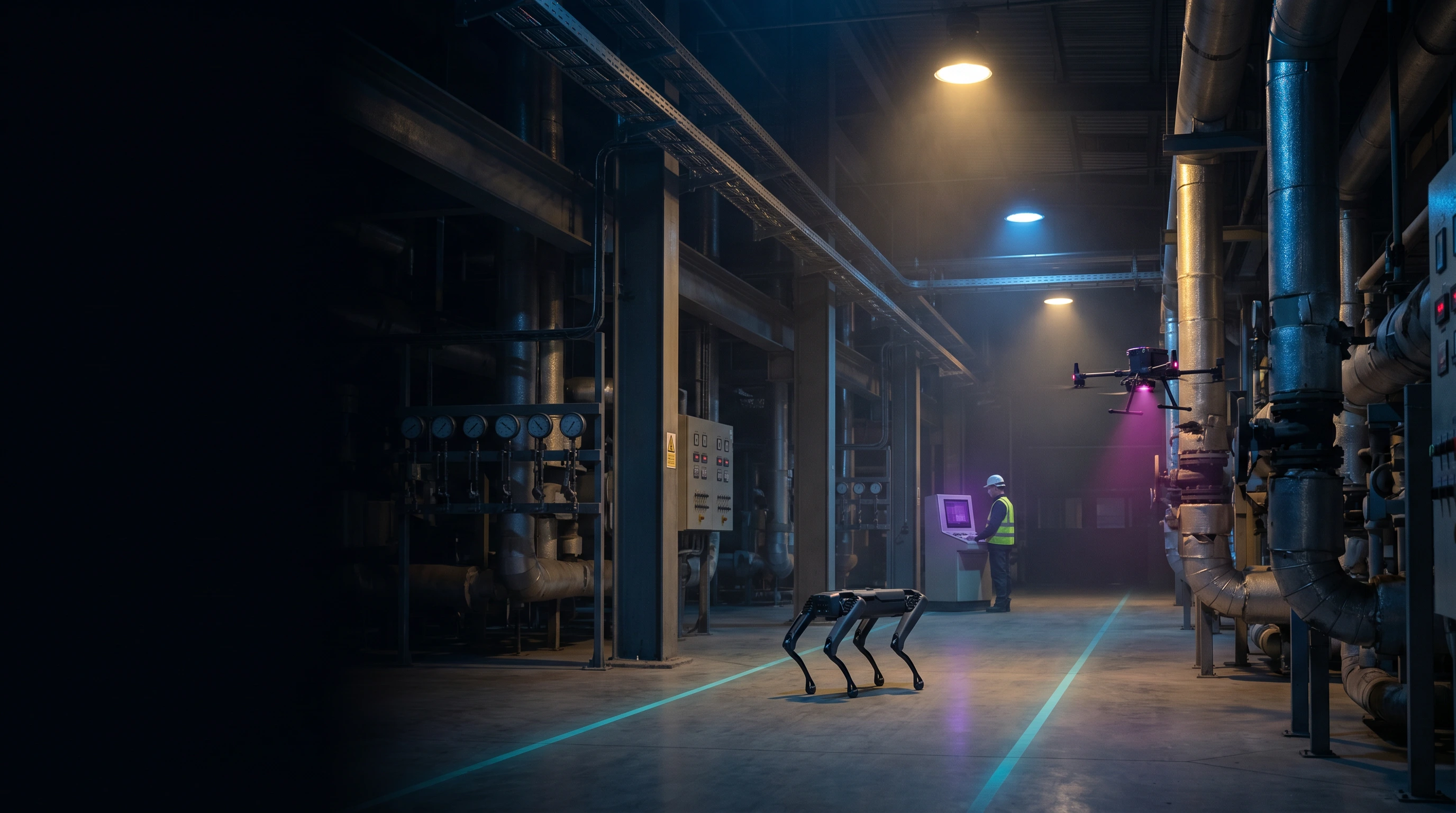
Industrial plant environment where Quanteon missions operate.
Managed service Swiss incorporated Regulated safety-critical infrastructure System-level assurance by design
01 Problem

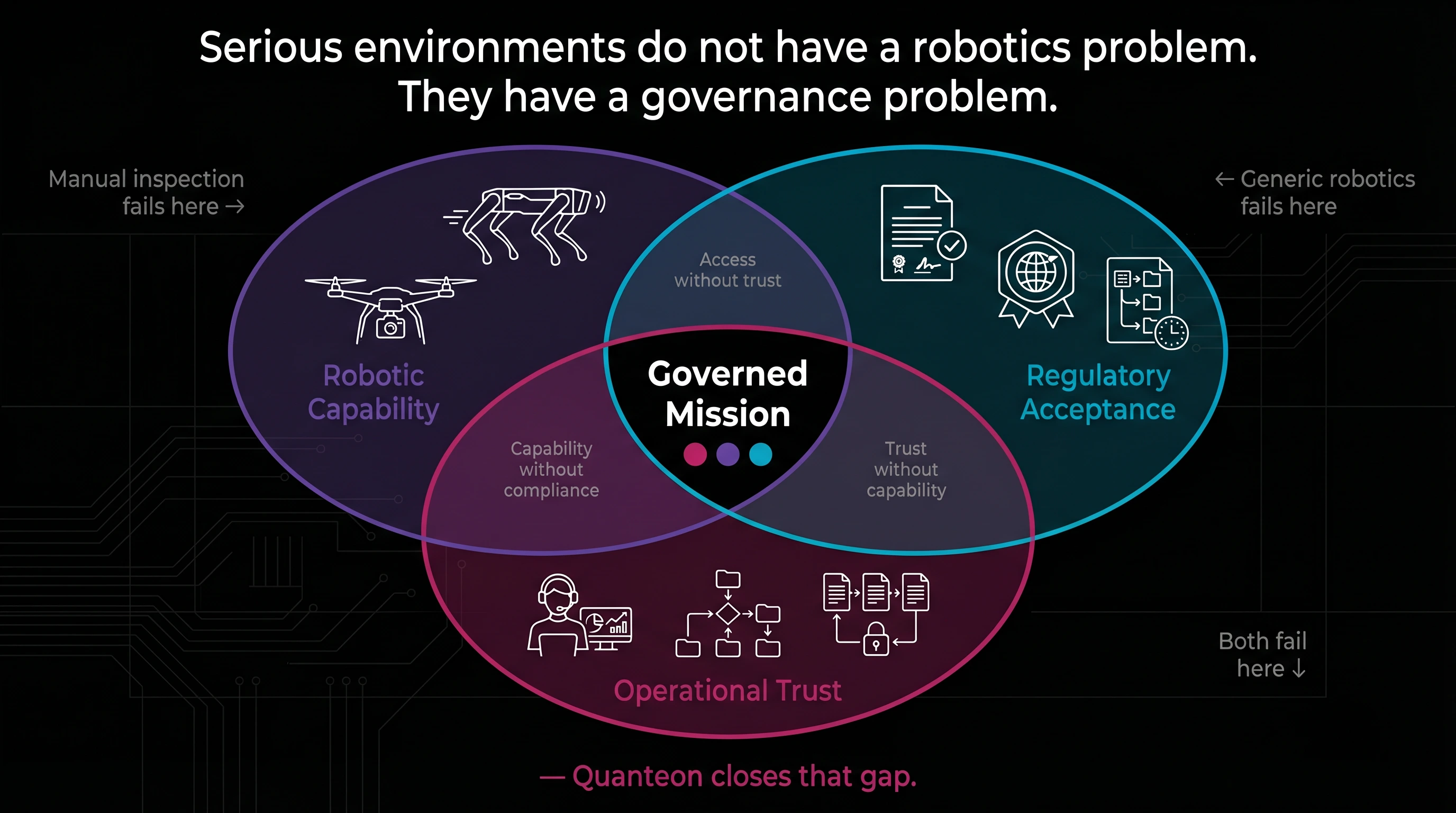
Serious environments do not have a robotics problem. They have a governance problem.

Critical infrastructure is caught between two failing answers to the same question. Manual inspection keeps people inside hazard zones and produces inconsistent evidence. Generic robotics reduces access friction but inherits no governance. Either way, the mission still has to be trusted by the plant, by the regulator, and by the operator on shift.

Comparison of manual inspection, generic robotics, and the governed operating model.
01

Human exposure is built into the current workflow.

Routine evidence capture still depends on people entering radiation-controlled areas, hazardous process zones, and confined spaces. Reducing routine exposure is a safety requirement, not a convenience.
02

The evidence chain is inconsistent.

Rounds vary by person. Findings are captured unevenly and escalated informally. In high-consequence environments, routine inspection is part of the barrier system. A weakly structured barrier is a weak barrier.

03

Commercial robotics does not close the trust gap.

Platforms improve reach. They rarely deliver approved configuration control, explicit degraded-mode behaviour, supervised operation, or auditable output chains.

04

The missing layer is governance.

The market does not lack robots. It lacks a governed operating model between robotic capability and operator trust.

That layer is what Quanteon builds.

02 Reference Missions

Representative deployments for serious environments.

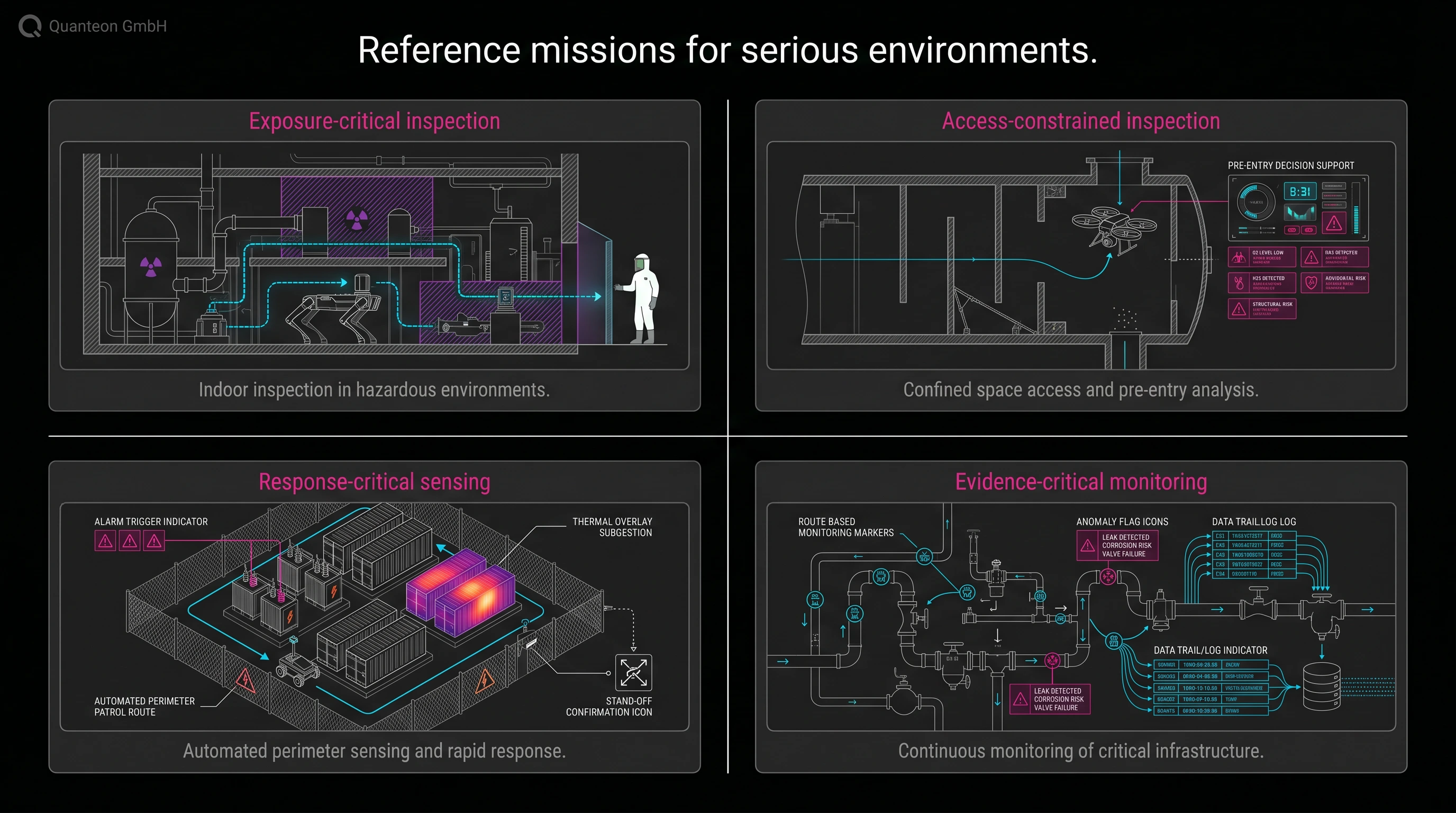
These reference missions show how Quanteon is deployed across hazardous, regulated, and difficult-access environments. They are representative examples, not a closed catalogue. Each deployment is scoped to the site, the hazard context, the operating envelope, and the evidence required.

Mission matrix across exposure, access, response, and evidence domains.
M01

Exposure-critical inspection

Where routine access puts people into hazardous or controlled environments.

Environments

Indoor nuclear inspection · radiation-relevant plant areas · hazardous process environments

Supervised robotic missions that reduce routine exposure, extend reach, and produce auditable inspection evidence.

M02

Access-constrained inspection

Where geometry, confinement, height, or enclosure make inspection slow, difficult, or unsafe.

Environments

Industrial storage tanks · voids and enclosures · ducts · enclosed plant spaces

Quadruped and drone missions for pre-entry inspection, internal visual confirmation, and difficult-access condition assessment.

M03

Response-critical sensing

Where operators need remote confirmation before approach, escalation, or intervention.

Environments

Critical infrastructure security · alarm verification · BESS response · stand-off thermal and visual confirmation after events

Governed remote-response missions structured for operator decision-making under time pressure.

M04

Evidence-critical monitoring

Where the value lies in repeatable, structured, and reviewable inspection output over time.

Environments

Steam trap inspection · leak detection · route-based refinery rounds · industrial condition monitoring

Route-based robotic monitoring that turns routine rounds into tagged findings, trendable observations, and maintenance-grade evidence.

These are reference missions, not the edge of the map. Where the environment is serious and the mission must be governed, Quanteon scopes the system accordingly.

03 How It Works

Five operating constraints. One governed chain.

03A Operating constraints

These are not slogans. They are the constraints every Quanteon mission is built against and measured against.

01

Every input is measured.

Every sensor has calibration traceability, known uncertainty, and a defined validity window.

02

Every failure is modelled.

Safety-relevant functions are analysed before deployment. Credible failure modes are identified, bounded, and assigned a response.

03

Every response is bounded.

Time-critical responses are automated. Judgement-critical decisions stay with humans.

04

Every state is monitored.

Health, position, environment, and operating limits are continuously checked and logged.

05

Every degradation is controlled.

Systems do not fail only in binary. They degrade. Quanteon detects degradation early and responds proportionally.

The constraints govern the mission before it runs, while it runs, and after it closes.

03B The governed chain

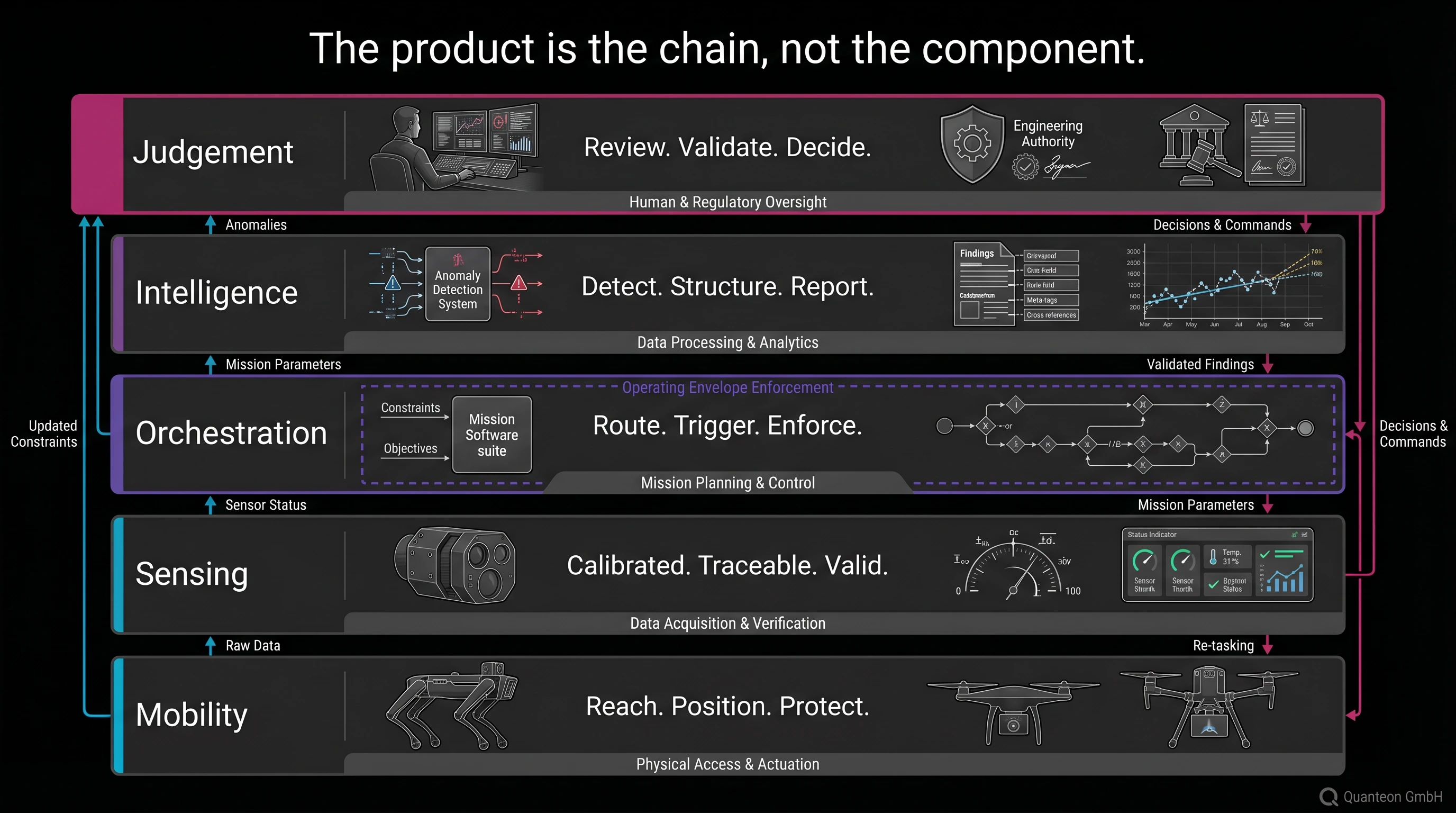
The product is the chain, not the component.

Five-layer inspection chain: mobility, sensing, orchestration, intelligence, judgement.
  1. L01

    Mobility

    Quadruped or drone provides physical access to the inspection target. Reach, position, protect.

  2. L02

    Sensing

    Payloads capture calibrated, traceable measurement data with known uncertainty and known sensor health.

  3. L03

    Orchestration

    Mission software coordinates route logic, sensor triggering, timestamping, and enforcement of the approved configuration and operating envelope.

  4. L04

    Intelligence

    Analytics turn raw data into structured findings, anomaly flags, trends, and reportable outputs.

  5. L05

    Judgement

    Humans review exceptions, validate non-standard findings, and make decisions that require engineering or regulatory authority.

Competitors sell layers. Quanteon delivers the governed chain and carries accountability for its output.

03C The states

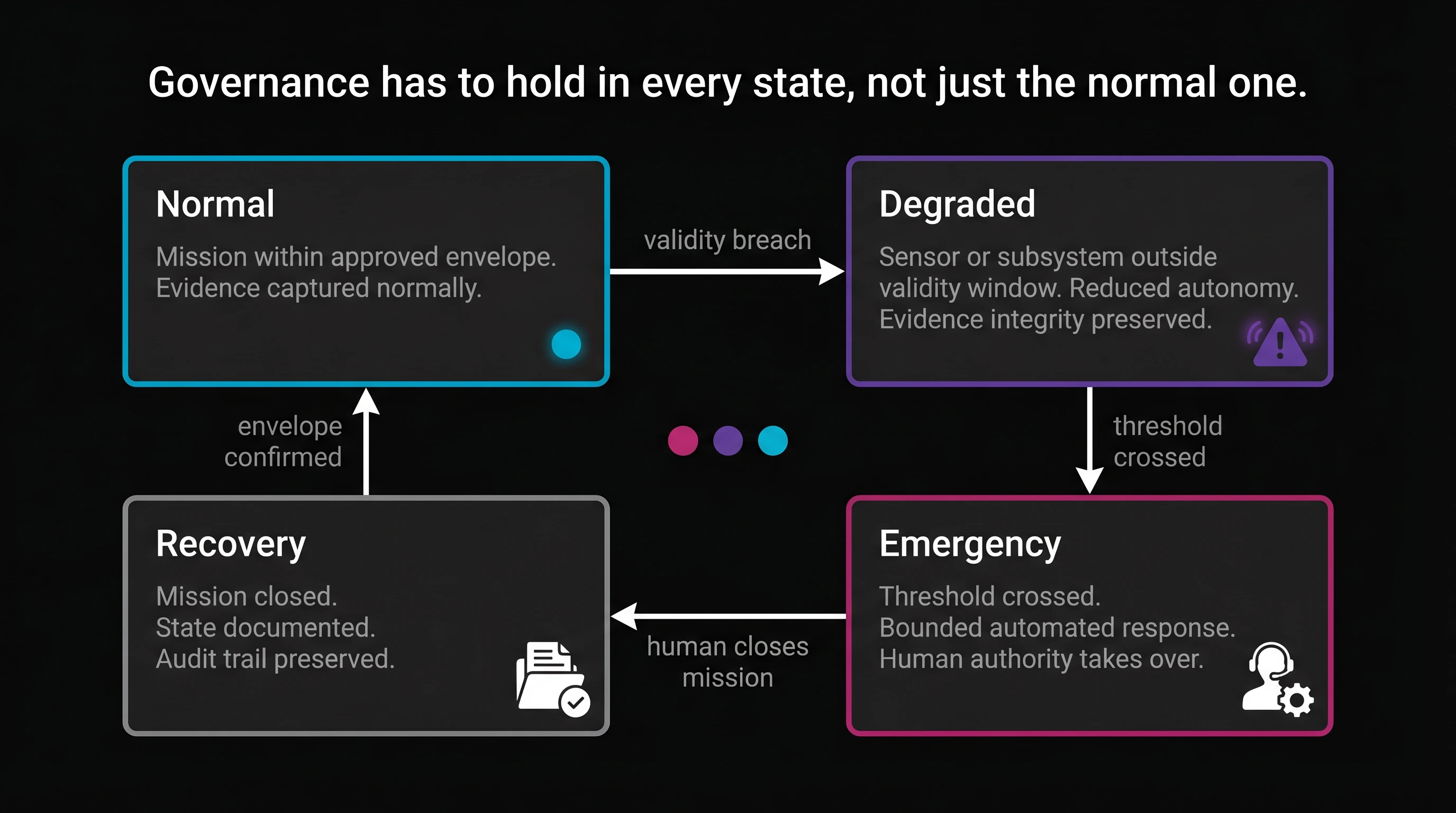
Governance has to hold in every state, not just the normal one. Most robotic deployments are validated in normal conditions. Governance is proven, or exposed, in the other three.

Operational state diagram: normal, degraded, emergency, recovery.
S01

Normal

The mission runs inside the approved envelope. Evidence is captured, logged, timestamped, and routed under the operating rules.

S02

Degraded

A sensor, subsystem, or environmental condition moves outside its validity window. The system detects the degradation, reduces autonomy proportionally, and preserves evidence integrity.

S03

Emergency

A safety-relevant threshold is crossed. Bounded automated responses execute. Judgement escalates to human authority.

S04

Recovery

The mission is closed, the state is documented, and the evidence chain remains auditable for the next shift, the next audit, and the next operator.

Trust is not earned in the normal state. It is earned in the other three.

03D Integrated delivery

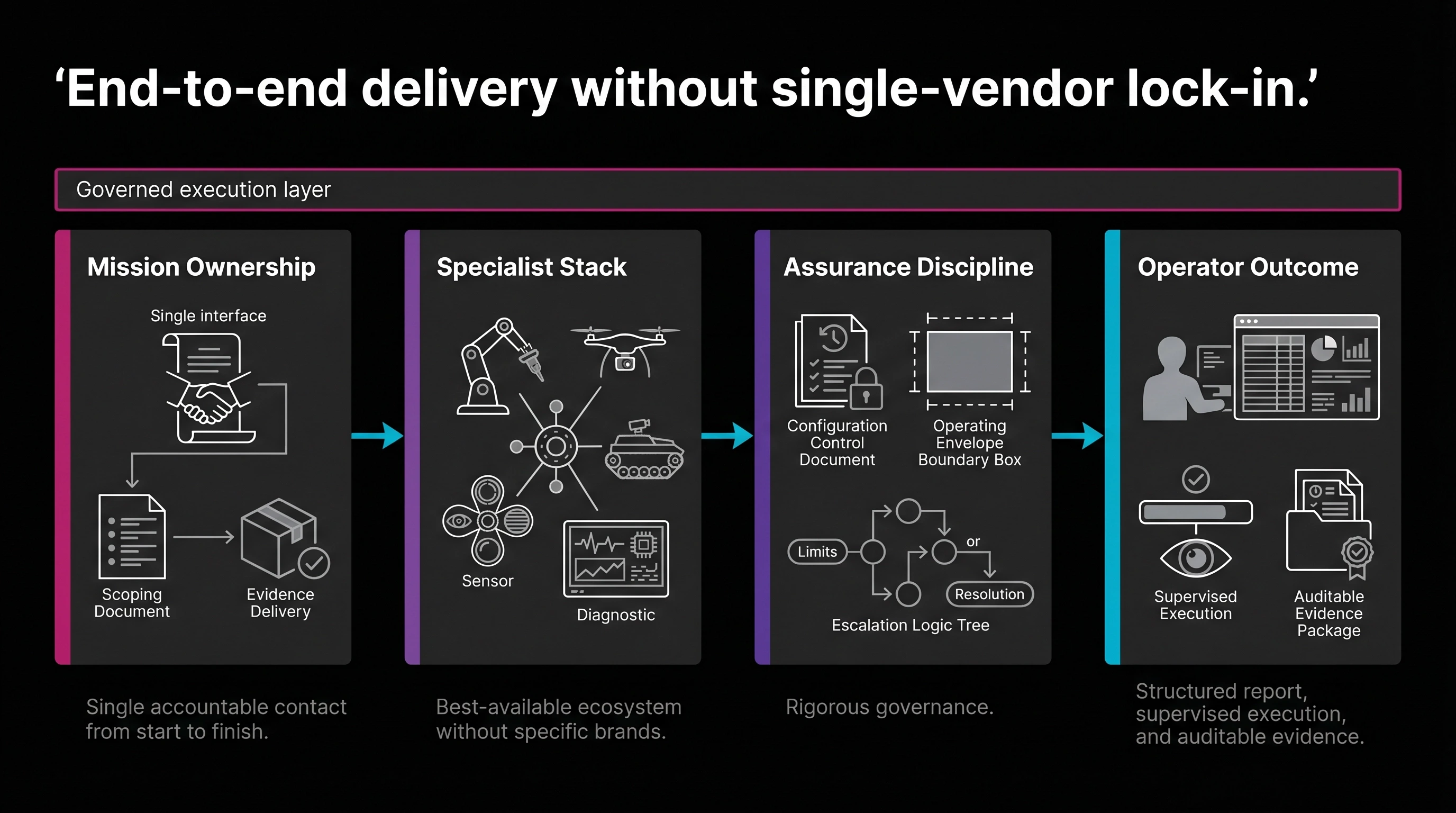
End-to-end delivery without single-vendor lock-in. Quanteon delivers governed missions end to end by combining mission control, robotics, sensing, diagnostics, assurance discipline, and field execution into one accountable operating model.

Operating model chain: mission control, robotics, sensing, diagnostics, assurance, and field execution as one accountable flow.
01

Mission ownership

One accountable interface from scoping through evidence delivery.

02

Specialist stack

Best-available robotics, sensing, diagnostics, and enabling technologies selected against the mission, not forced by a single-vendor catalogue.

03

Assurance discipline

Configuration control, documented escalation, and operating-envelope logic govern the full chain.

04

Operator outcome

The client receives supervised execution and auditable evidence, not an integration project.

Quanteon integrates the chain, governs the interfaces, and carries accountability for the result.

03E Service model

Quanteon delivers governed inspection and remote-response missions as a managed service. Every mission runs under a defined operating envelope, an approved configuration, and a documented escalation path. Hardware risk stays with Quanteon. The client buys supervised execution, auditable evidence, and operational accountability.

The robot is part of the stack. The governed mission is the product. Evidence is the deliverable.

04 Certification

The target baseline is the full system, not isolated components.

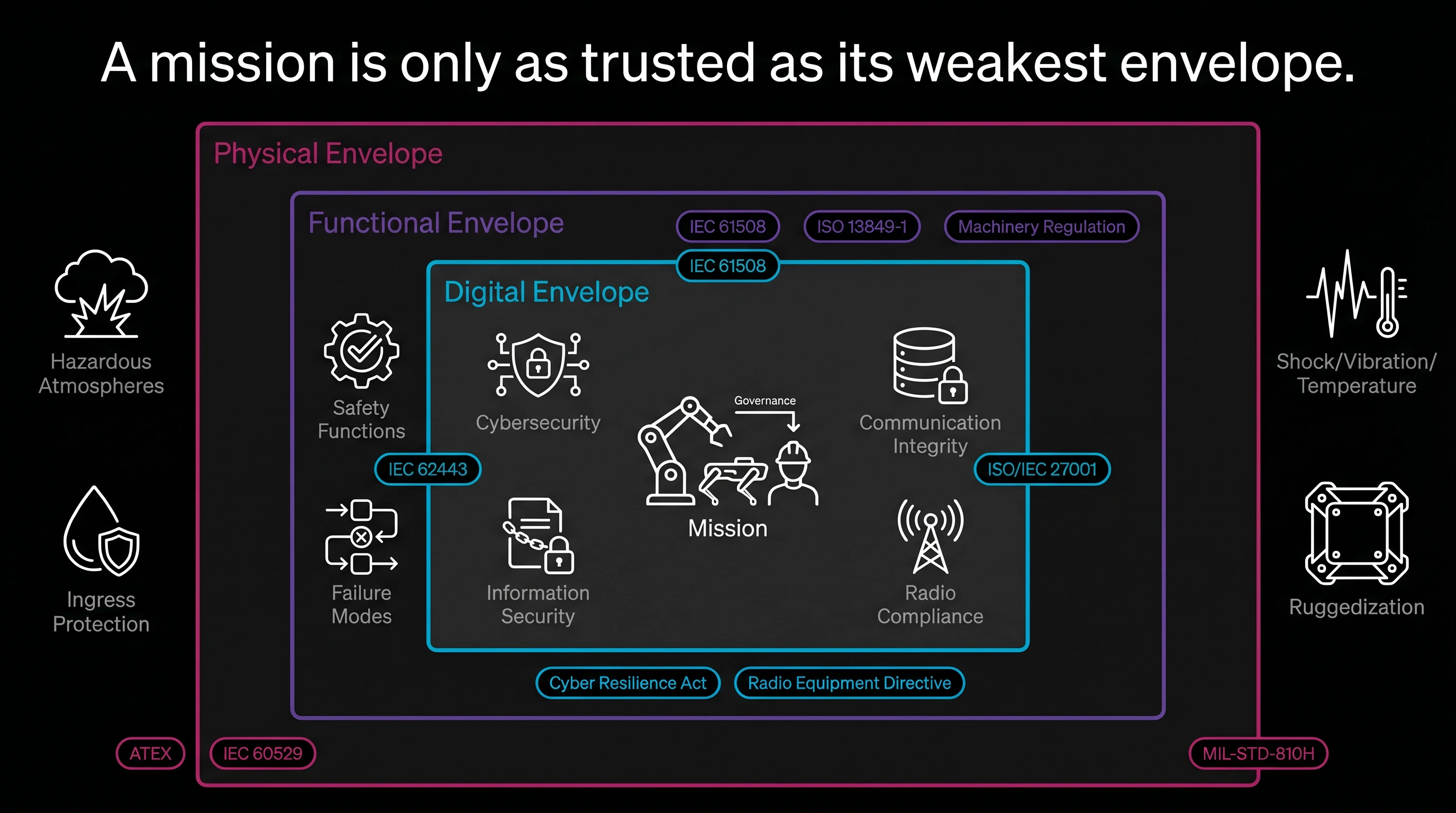
The assurance stack is both a trust requirement and a barrier to entry. Quanteon treats documentation, test evidence, cybersecurity, configuration control, and design rationale as core assets, not paperwork. Every mission runs inside three envelopes. Each envelope has its own standards, its own evidence, and its own failure modes.

Nested assurance envelopes: physical, functional, digital.
E01

Physical envelope

where the mission can operate

Explosive atmospheres, ingress, shock, vibration, and temperature define the conditions the hardware must survive before the mission can be trusted on site.

  • ATEX
  • IECEx
  • IEC 60529
  • MIL-STD-810H (reference)
E02

Functional envelope

how the mission behaves

Safety functions, failure modes, machinery compliance, and the rules that bound autonomous behaviour determine whether the system remains controlled when conditions degrade.

  • IEC 61508
  • ISO 13849-1
  • Machinery Regulation
  • AI obligations where applicable
E03

Digital envelope

how the mission is governed and secured

Cybersecurity, data custody, information security, and radio compliance determine the integrity of what the mission sees, stores, transmits, and relies on.

  • IEC 62443
  • ISO/IEC 27001
  • Cyber Resilience Act
  • Radio Equipment Directive

Pre-certification pilots run under a separate pilot configuration in non-hazardous zones. Hazardous-zone deployment follows certification completion and approval for the relevant envelope.

A mission is only as trusted as its weakest envelope.

05 Team

Built by operators and mission-critical systems engineers.

Benjamin Regener

CEO · Co-Founder

Mechanical engineer, TU Munich. Fifteen years across nuclear, critical infrastructure, and highly regulated technologies, spanning asset integrity, diagnostics, robotics evaluation, and commercial strategy in safety-critical environments.

Milan Misic

CTO · Co-Founder

Systems engineer and mission-critical software specialist. Built and deployed counter-drone command-and-control capability under live operational constraints. Focused on real-time control, systems architecture, and safety-critical software design.

Quanteon is built from the operator side of the hand-off, where missions must survive real constraints, real scrutiny, and real approval logic.

North star

Governed autonomy. Everywhere. All the time.

Today, Quanteon earns that claim one governed mission at a time.

06 Contact

Bring us the mission others treat too lightly.

If the mission lives in a hazardous area, controlled zone, confined space, or regulated asset environment, Quanteon will scope it against the real constraints, not the demo assumptions.

Request pilot brief
Location
Zurich, Switzerland